






 Rumah
Rumah Produk



Pengenalan
Sachet ialah bungkusan fleksibel kecil yang dimeteraikan yang digunakan untuk menyimpan sejumlah produk yang telah diukur. Contoh biasa termasuk paket gula, kopi segera, perasa, sampel syampu, sos dan serbuk suplemen.
Pembungkusan sachet boleh mengendalikan serbuk, granul, cecair, gel, krim dan produk lain yang boleh dialirkan apabila sistem pengisian dan bahan pembungkusan dipadankan dengan produk. Ini menjadikan format ini berguna merentasi aplikasi makanan, nutraseutikal, farmaseutikal, kosmetik, penjagaan diri dan isi rumah.
Di sebalik bungkusan kecil itu terdapat proses pembungkusan yang lengkap: tingkah laku produk mempengaruhi kaedah pengisian, keperluan perlindungan mempengaruhi struktur filem, dan reka bentuk paket menentukan bagaimana bungkusan dibentuk dan dimeteraikan.
Panduan ini menerangkan apa itu sachet, jenis-jenis utama pembungkusan sachet, apa yang boleh terkandung di dalamnya, bahan yang digunakan dan bagaimana sachet komersial dibentuk, diisi, dimeteraikan dan dipotong.
1. Apakah itu Sachet?
Sachet ialah bungkusan fleksibel kecil yang mengandungi kuantiti produk yang diukur atau terhad di dalam bahan pembungkusan yang tertutup rapat. Ia biasanya digunakan untuk kebolehgunaan, kawalan bahagian, pensampelan atau penggunaan sekali sahaja.
Istilah pek sachet menggambarkan bungkusan siap dan bukannya satu kaedah pembinaan. Struktur biasa termasuk pengedap tiga sisi, pengedap empat sisi dan sachet pengedap belakang, manakala garisan luar siap boleh berbentuk segi empat tepat atau berbentuk khas.
Bagaimana Rupa Sachet?
Kebanyakan paket diperbuat daripada bahan pembungkusan fleksibel yang dibekalkan sebagai filem gulung dan mengandungi tiga elemen asas:
- Badan bungkusan, yang mengelilingi dan memegang produk.
- Kawasan yang tertutup rapat, yang menutup bungkusan dan membantu melindungi kandungannya.
- Ciri pembukaan, seperti takuk koyak atau tepi mudah koyak, apabila diperlukan oleh reka bentuk pakej.
Bahan pembungkusan boleh jadi filem ringkas atau lamina berbilang lapisan yang menggabungkan beberapa fungsi.
Lapisan yang berbeza boleh memberikan kebolehcetakan, kekuatan mekanikal, perlindungan kelembapan atau oksigen, perlindungan cahaya dan prestasi pengedap haba.
Struktur yang betul bergantung pada produk. Perasa kering, serbuk suplemen sensitif kelembapan dan sos cecair mempunyai permintaan yang berbeza terhadap perlindungan penghalang, prestasi pengedap dan kekuatan pembungkusan.
Sachet vs. Pouch: Apakah Perbezaannya?
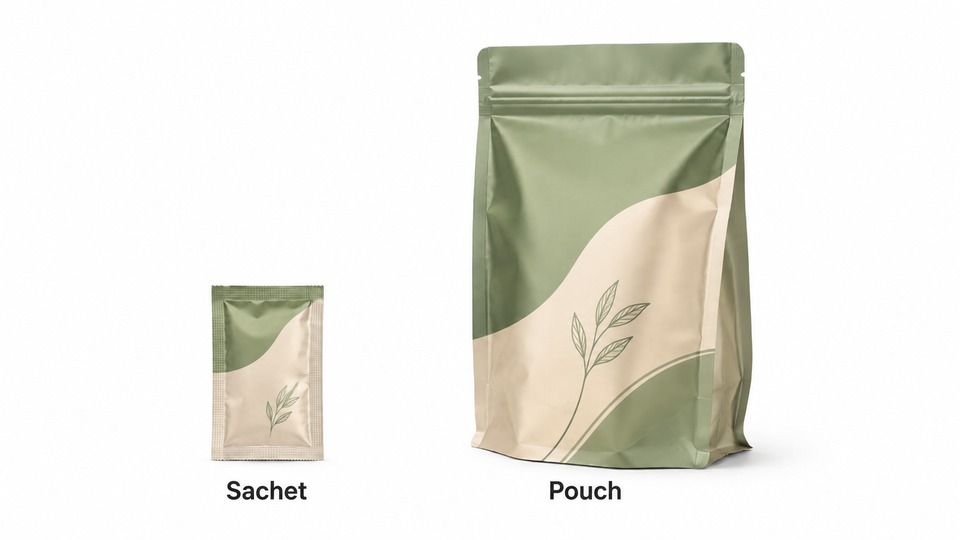
Sachet ialah sejenis pakej fleksibel, manakala pouch ialah istilah pembungkusan yang lebih luas.
Dalam penggunaan pembungkusan biasa, paket biasanya merujuk kepada pek yang lebih kecil yang mengandungi jumlah yang diukur atau terhad, manakala kantung meliputi pelbagai saiz dan format yang lebih luas, termasuk kantung berdiri, zip dan muncung.
Tiada saiz universal di mana satu paket menjadi satu kantung, jadi istilahnya boleh bertindih antara industri.
Banyak paket kecil dibentuk daripada filem gulung padamesin pembungkusan sachet, manakala lebih besar atau lebih komplekskantung sering dibekalkan siap pakaidan kemudian dibuka, diisi, dan dimeteraikan secara individu.
2. Apakah Jenis-jenis Utama Pembungkusan Sachet?
Cara paling jelas untuk mengklasifikasikan jenis pembungkusan paket adalah pertama sekali melalui struktur pengedap, kemudian secara berasingan melalui bentuk dan ciri khas.
Sachet Meterai Tiga Sisi
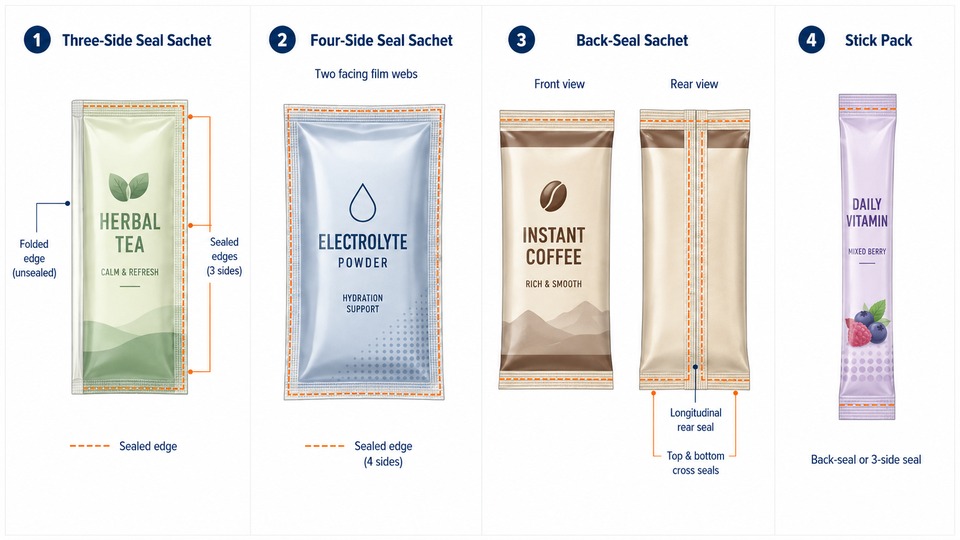
Satu paket pengedap tiga sisi biasanya dibentuk daripada satu jaring filem yang dilipat untuk menghasilkan satu tepi tertutup; tiga tepi yang lain dikedap haba.
Hasilnya ialah bungkusan yang rata dan padat yang digunakan secara meluas untuk serbuk, granul, cecair, sampel dan bahagian kecil yang lain.
Sachet Meterai Empat Sisi
Satu paket pengedap empat sisi biasanya dibentuk daripada dua sarang filem yang diletakkan bersemuka dan dimeteraikan di sekeliling keempat-empat tepinya. Kedua-dua sarang itu mungkin datang daripada gulungan berasingan atau daripada celah gulungan tunggal kepada dua sarang.
Ia biasanya digunakan untuk serbuk, granul, cecair, krim dan gel.
Sachet Penutup Belakang
Satu paket pengedap belakang dibentuk dengan membalut filem di sekeliling bahagian pembentuk, mewujudkan pengedap belakang membujur dan menambah pengedap silang atas dan bawah.
Pek Kayu: Format Dos Tunggal yang Sempit
Pek kayu ialah bungkusan fleksibel yang sempit dan memanjang. Bergantung pada reka bentuk pembungkusan, ia boleh menggunakan struktur pengedap belakang atau pengedap tiga sisi. Pek kayu digunakan secara meluas untuk serbuk minuman, makanan tambahan, gula, granul dan beberapa cecair.
| Format / Struktur Meterai | Bentuk Lazim | Produk Biasa | Ciri Utama |
|---|---|---|---|
|
Meterai tiga sisi |
Rata, segi empat sama atau segi empat tepat |
Serbuk, granul, cecair |
Satu tepi yang dilipat dan tiga tepi yang dimeteraikan |
|
Meterai empat sisi |
Rata, segi empat sama atau segi empat tepat |
Serbuk, cecair, krim, gel |
Dua jaring filem yang dimeteraikan di keempat-empat sisi |
|
Penutup belakang |
Bentuk segi empat tepat atau bantal |
Serbuk, granul, cecair |
Meterai membujur belakang serta meterai silang atas dan bawah |
|
Pek kayu (format) |
Sempit dan memanjang |
Serbuk, granul, cecair |
Format memanjang sempit; seni bina pengedap berbeza mengikut reka bentuk mesin pek kayu |
Bentuk Sachet dan Reka Bentuk Khas
Uncang tiga sisi, empat sisi dan penutup belakang juga boleh menggunakan garis besar atau ciri kemudahan yang berbeza.
Contoh biasa termasuk:
- Uncang segi empat tepat, bentuk yang paling biasa dan ringkas.
- Uncang berbentuk, dengan garisan melengkung, bulat atau tersuai untuk pembentangan produk atau kegunaan khusus.
- Uncang bertakuk koyak, direka bentuk untuk memudahkan pembukaan manual.
- Sachet dengan lubang gantung, membolehkan pek dipaparkan pada cangkuk runcit jika diperlukan.
3. Apakah Bahan yang Boleh Dikemas dalam Sachet dan Apakah Bahan yang Diperbuat daripada Sachet?
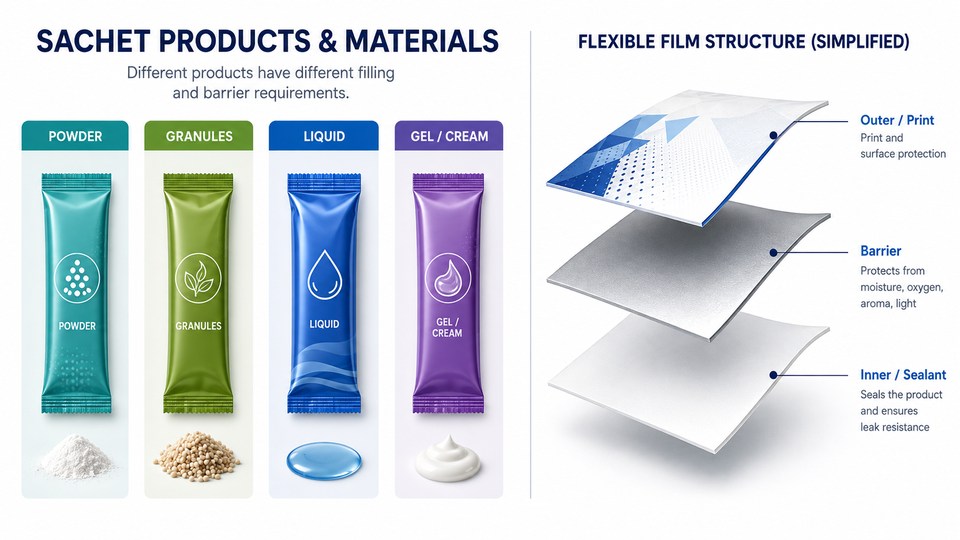
Sachet boleh memuatkan pelbagai jenis produk, termasuk serbuk, granul, cecair, gel, krim dan pes. Bahan pembungkusan kemudiannya dipilih mengikut ciri-ciri produk dan keperluan perlindungan, pengedap dan pengendalian sachet yang telah siap.
Serbuk dan Granul
Fine powders can retain air, bridge, or stick, while free-flowing granules such as sugar and salt behave differently.
Powders can use auger dosing, while free-flowing granules can use suitable volumetric systems.
Seal-zone contamination is not simply a lack-of-space problem. Fine powder can remain airborne, cling to film through static, or continue to fall from the filling tube after dosing. Nozzle position, cut-off timing, dust extraction, static control, and settling time should be checked together to keep the sealing area clean.
Liquids, Gels, Creams and Pastes
The filling method depends strongly on viscosity: a thin liquid needs different pumping and nozzle characteristics from a thick sauce or cream.
Higher-viscosity products also require controlled filling and cut-off to keep material out of the seal area.
A sachet filling machine should therefore be selected according to both package size and product characteristics.
Sachet Packaging Materials
Sachets can use plastic films, aluminum-containing laminates, paper-containing structures, and other multilayer combinations.
Multilayer materials combine functions: an outer layer can support printing and strength, a barrier layer can reduce moisture, oxygen, or light exposure, and an inner layer can provide heat-sealing performance.
An aluminium foil sachet can be selected when stronger light, moisture, or gas barrier performance is needed.
Other products can use transparent, metallized, or paper-containing structures according to protection, appearance, cost, sealability, and storage needs.
4. How Are Sachets Made?
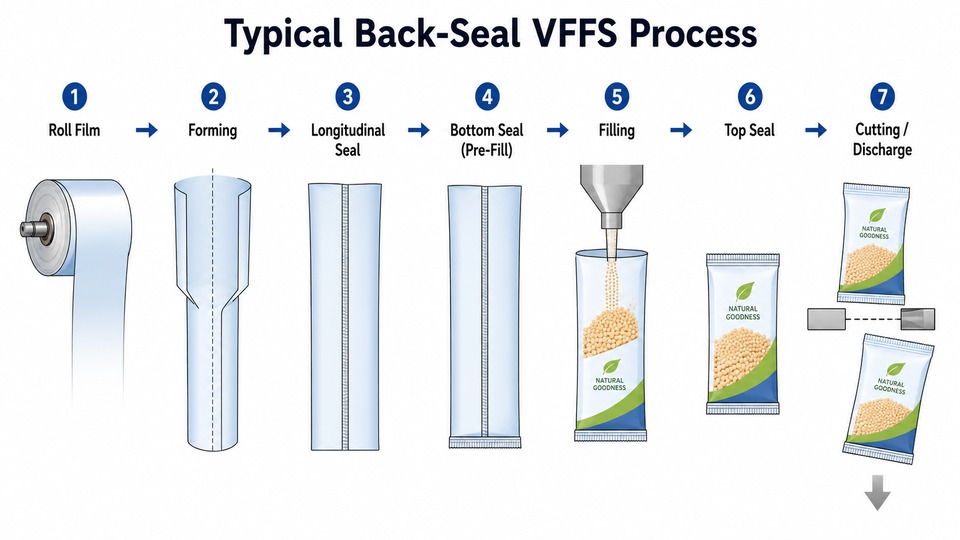
Commercial sachets are commonly produced by form-fill-seal equipment. Film is formed into the required structure, the necessary initial seals create a closed-bottom pocket or tube, product is dosed, and the package is finally closed and cut.
The exact web arrangement and sealing order vary with the sachet format and product.
Step 1: Film Unwinding and Feeding
Production begins with flexible packaging material supplied in roll form.
Thesmall sachet packing machineunwinds and guides the film toward the forming area while controlling movement and tension.
With preprinted film, registration marks help align the print, seal, and cut positions.
Step 2: Registration and Sachet Forming
The film is positioned and formed according to the required package design.
A back-seal format wraps film around a forming section before creating a longitudinal seal. Three-side sachets typically use one folded web, while four-side-seal lines typically bring two webs together.
In a typical back-seal VFFS cycle, the longitudinal seal forms the tube and a cross seal creates the closed base before the product dose is released.
Step 3: Product Dosing and Filling
Once a closed-bottom pocket or tube is ready, the filling system measures and delivers the required dose.
Different products require different dosing methods:
- powders can use auger dosing;
- free-flowing granules can use suitable volumetric systems;
- liquids can use piston, peristaltic, or other suitable metering pumps;
- creams, gels, and pastes require filling systems designed for higher-viscosity products.
A sachet packaging machine must match both the package format and the product. Two products using the same sachet size can still require different filling systems.
Step 4: Closing and Sealing the Sachet
For a typical back-seal VFFS cycle, the bottom cross seal is already present before filling. After dosing and film advance, the horizontal jaws create the top seal of the filled sachet and the bottom seal of the next one in the same action. Three-side and four-side machines use different web paths and sealing sequences, but the product is still delivered into a package section that is already closed at the bottom or formed as a supported open pocket.
Heat-sealing performance depends on temperature, pressure, contact time, film structure, and clean sealing surfaces.
Powder dust, liquid droplets, or paste in the sealing area can interfere with reliable seal formation.
Step 5: Cutting and Discharge
After the closing seal, the web is cut into finished sachets.
The machine can produce individual or connected sachets, while coding, tear-notch forming, counting, or downstream transfer can be integrated when required.
For a typical back-seal VFFS line, the sequence is:
film feeding -> registration and forming -> longitudinal sealing -> bottom/cross seal -> dosing and filling -> top/closing seal -> cutting -> discharge
This continuous sequence allows a modern sachet filling machine to produce small packages automatically at production scale.
5. Why Is Sachet Packaging Used and How Do You Choose the Right Format?
Sachet packaging combines compact size, controlled portions, flexible material options, and convenient handling.
It is useful for single servings, samples, travel sizes, measured ingredients, and products kept individually sealed until use.
They are not ideal for every application. Small packs provide limited print space, product in the seal area can affect seal quality, and some multilayer high-barrier structures are difficult to recycle through conventional streams.
Choosing the right sachet should start with the product.
| Factor | Why It Matters |
|---|---|
|
Product form |
Determines the filling and dosing system |
|
Portion size |
Influences sachet dimensions and filling range |
|
Barrier requirement |
Helps determine the film structure |
|
Sealability |
Affects material and sealing conditions |
|
Sachet format |
Determines forming and sealing configuration |
|
Production output |
Influences machine speed and automation level |
|
Changeover needs |
Matters when multiple products or sizes share one line |
Production speed should not be considered alone. A faster machine adds little value if the dosing system cannot handle the product consistently or the film cannot form reliable seals.
For pharmaceutical, nutraceutical, food, and similar production environments, cleanability, product-contact design, material handling, andline integrationare also important.
Conclusion
So, what is a sachet?
A sachet is a small sealed flexible package for a measured or limited amount of powder, granules, liquid, gel, cream, or another suitable product.
The finished pack reflects several connected decisions. Product flow behavior, viscosity, and target dose first determine the dosing or filling method. The target dose and package requirement then define sachet dimensions and seal format; where a forming tube is used, these dimensions determine the suitable forming set. Barrier and sealability requirements then determine the film structure.
The selection sequence is:
product characteristics and target dose -> dosing/filling method -> sachet dimensions and seal format -> forming set or tube where applicable -> film barrier and sealability requirements -> sachet filling and sealing machine configuration and production trial
With years of experience in pharmaceutical and packaging machinery, Rich Packing provides sachet packaging solutions with product-specific filling, servo-controlled dosing, and temperature-controlled sealing. These capabilities help match the filling and sealing system to different products and sachet formats.
Frequently Asked Questions
1. What is a sachet?
A sachet is a small sealed flexible package used to hold a measured or limited amount of product, including powders, granules, liquids, creams, gels, food ingredients, supplements, and cosmetics.
2. What is the difference between a sachet and a pouch?
A sachet usually refers to a smaller flexible package for a measured or limited quantity, while pouch is a broader term covering formats such as stand-up, zipper, and spouted pouches.
3. What is the difference between a sachet and a stick pack?
A stick pack is a narrow, elongated single-dose format. Its seal structure can be back-seal or three-side-seal.
4. What products can be packed in sachets?
Sachets can handle powders, granules, liquids, gels, creams, and pastes when the filling system and packaging material suit the product.
5. What are sachets made from?
Sachet boleh dibuat daripada filem plastik, laminasi kerajang aluminium, struktur yang mengandungi kertas dan bahan berbilang lapisan lain yang dipilih untuk keperluan pengedap, percetakan, kekuatan dan penghalang.
6. Bagaimanakah mesin pembungkusan sachet berfungsi?
Mesin pembungkusan sachet membentuk filem gulung, mengukur produk, melengkapkan pengedap yang diperlukan dan memotong sachet yang telah siap. Urutan dos dan pengedap berbeza mengikut reka bentuk produk dan pakej.
Rujukan
- Bentuk/Isi/Meterai Menegak 101: Pertimbangan Utama. Dunia Pembungkusan.
- Kriteria Filem untuk Aplikasi Bentuk/Isi/Meterai Menegak. Dunia Pembungkusan.
- Sistem Penutupan Kontena untuk Pembungkusan Ubat-ubatan Manusia dan Biologi. Pentadbiran Makanan dan Ubat-ubatan AS.
- Definisi Pembungkusan Fleksibel. Persatuan Pembungkusan Fleksibel.


 Rangkaian IPv6 disokong